
Conversing with two smeltermen
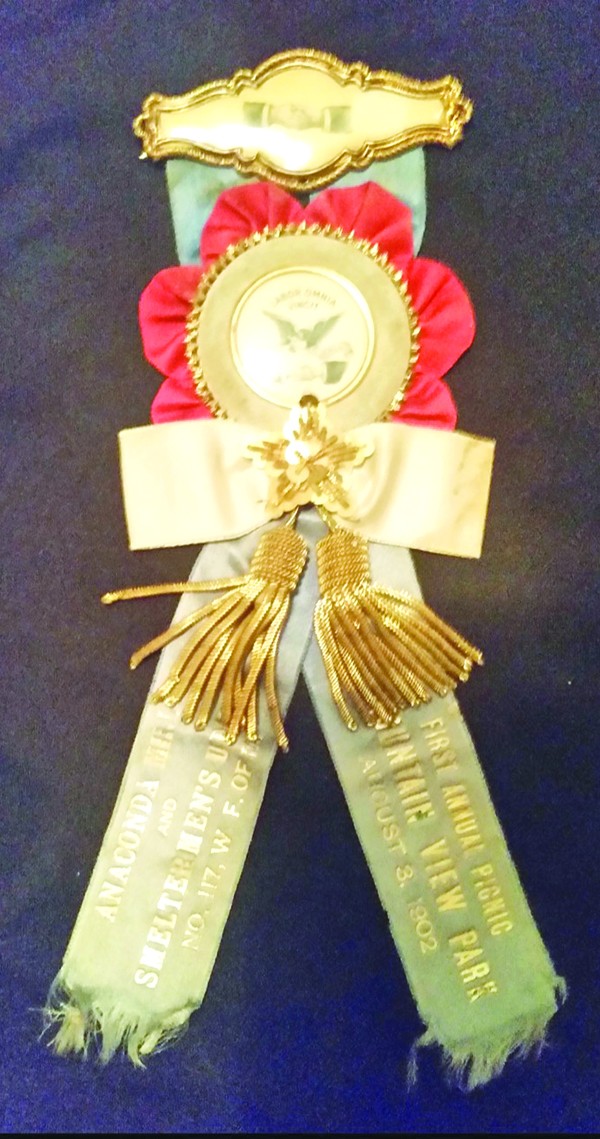
A ribbon from the first Smeltermen's Day Picnic

An Anaconda Mill and Smeltermen's Union ribbon from John Forkan's collection are pictured here.
Seeking out a smelterman to share stories of “The Hill” in honor of Smeltermen’s Day – along with tales of the big day itself from days past – the Anaconda Leader found two: Jim Van Fossen and John Forkan.
Van Fossen clearly remembers working for the BA&P (Butte, Anaconda, & Pacific Railway) when he was only 18 years old.
“I remember this massive equipment that would pick up a 70 ton ore car that had just come by rail from Butte and tip it upside down and the copper ore would fall out on the conveyor belt, take that ore to the crushers and they would pulverize that into an almost small grain sand like material, and that was the first process of the ore coming from Butte,” Van Fossen said.
He recalled men that cleaned the arsenic flue, which had two chambers, one would be closed for maintenance while the other was operational. It created a draft that swept the arsenic up through the stack and down the Deer Lodge Valley.
“I remember these guys, happy as can be, wrapped in gauze to protect their skin from burning from the arsenic dust,” he said. “The most poignant memories I have are the Smeltermen and how they appear in their work clothes dressed in overalls, work boots, and page boy hats. I remember the trolleys and later the buses going down 3rd street taking the Smeltermen to their jobs. I got a strong sense of the comradery that they had. These guys that worked together, there was really a brotherhood. Everybody was looking out for everyone else cause it was a dangerous environment.”
“Another memory I have is the plumes of smoke that came out of the smelter, just billowed out, and when you’re near the stack, when they had all the machinery going, and the size of the stack, and the men busy working up there, it was quite an operation,” he continued.
There is no shortage of nostalgic stories that come to Van Fossen’s mind. However, the most impactful memories touch deep into his heart, and that is the heroic character and skill of his veteran co-workers.
“The amazing thing to me was the foundry workers who assembled, fabricated and made the equipment and the furnaces and all of the gears and machinery and engines that went into producing copper. These guys were just incredible craftsmen.”
Van Fossen didn’t live in Anaconda in 1980 when the smelter closed down, but he remembers hearing the stories about it and it was truly unbelievable. Just recently, after decades of being away, he decided to take a leap and move back, albeit part time for now.
“I came back because I love the soul of Anaconda. I love the people. I love the bones of Anaconda,” he said. “They did a lot of bad things and harm, in particularly to the environment, but they also donated the land, built and maintained the Washoe park and would put on an unbelievable Smeltermen’s Day August 8th of every year in the park and everybody got the opportunity to run in the race, and if you ran in the race, you got a silver dollar and you could eat as much ice cream and candy as you wanted. It was just a rich time and I look back at it as a time of innocence.”
Forkan also worked at the smelter, a couple times in fact, starting after high school and before college. He worked in the converters and on the bull gang where they bounced around working on different things. He went to work for BP&A for about six months until the Anaconda Company went on strike and shut down the Smelter and the railroads.
“I collect all kinds of union memorabilia and I have some older ribbons that I post on Facebook every Aug. 8. One of them is from the Western Federation of Miners, Mill, and Smelter Workers from around the late 1890s, and I also have a ribbon from the first Smeltermen’s Day picnic,” Forkan said.
Why was the smelter so important to Anaconda?
“Well it was the lifeline. Everything revolved around it. That was the main industry of the community. Everything revolved pretty much around the Smelter. Smeltermen played a big part in all of that. As kids growing up, Smeltermen’s was probably the day of the year. They had a parade. They went out into Washoe park. They had races and a picnic. Towards the end, the Smeltermen always put out a big line of tables end to end and the kids would walk down through there and get treats; passes to the Washoe theater, wooden nickels, and as you got to the end everyone got a dixie cup with a wooden spoon. And the last thing you got was a silver dollar,” Forkan said.
Oh, the silver dollars. They are, undoubtedly, the highlight of every child’s memory at that time, according to many stories.
“They would put a silver dollar in the hand of every single kid that come through that line. Then they had races and all this other stuff, and the winner of the races got silver dollars. It was a big community day. We used to look forward to that,” he said.
Then, in 1980, the smelter shut down. He recalls how it affected the community.
“Oh it devastated it. You had the mines in Butte, Smelter in Anaconda, and the refinery in Great Falls. Those were the main industries of those three towns. It just knocked everybody back on their heels. Thousands of workers and families that were impacted by that. It pulled the rug out from all of those workers and families,” he continued.
“It was just a way of life, it was a company town, and it was the Anaconda Company that made it that way. It had such a negative impact on so many. Pretty tough for 50 year olds to relocate after they’ve been working up there for 30 years, ya know. I know a lot of people had to sell their homes, if they could. There wasn’t much home buying going on after that,” he said.
Strikes weren’t necessarily unheard of for the Anaconda Company. They would typically strike every couple of years after their contracts ran out. However, prior to 1980, they managed to salvage things. Until they didn’t. Nevertheless, unions were a pivotal piece of just about every single profession at that time, certainly smelter workers.
“When I was growing up in Anaconda, anyone who had a job was probably union. All the clerks in the stores, I mean, I was a bartender. If you were a bartender you belonged to that union,” he said.
Now, more than four decades after the smelter’s closure, Anaconda continues to recognize and celebrate the entity – and more importantly, the people – that created this town, and has no plans of letting up anytime soon.
Be sure to get out and enjoy Smeltermen’s Day this weekend and experience a bit of the incredible history that Anaconda has to offer.
Category:

